Was this newsletter forwarded to you? Sign up to get it in your inbox.

We analyze emerging AI research, developer tools, and infrastructure architecture to help companies transition from intelligence to execution.
Artificial intelligence is undergoing its most significant transition since the launch of ChatGPT.
For the past few years, the technology sector has operated in a state of collective infatuation with Generative AI. We built bigger parameters, fed them broader subsets of the public internet, and marvelled at their capacity to converse. We asked one primary question: Can AI generate? We celebrated when it could write poetry, mimic corporate prose, construct syntax-valid code, and paint surrealist imagery on demand.
Yet, behind the initial wave of excitement, a quiet tension has been building in corporate boardrooms, developer standups, and research labs alike. The text boxes we interacted with remained isolated. They were reactive interfaces—passive loops waiting for a prompt, generating an answer, and immediately forgetting the context. Chatting with an LLM was a novelty that saved a few minutes of writing email templates or drafting basic functions. It did not, however, restructure the actual unit economics of human work.
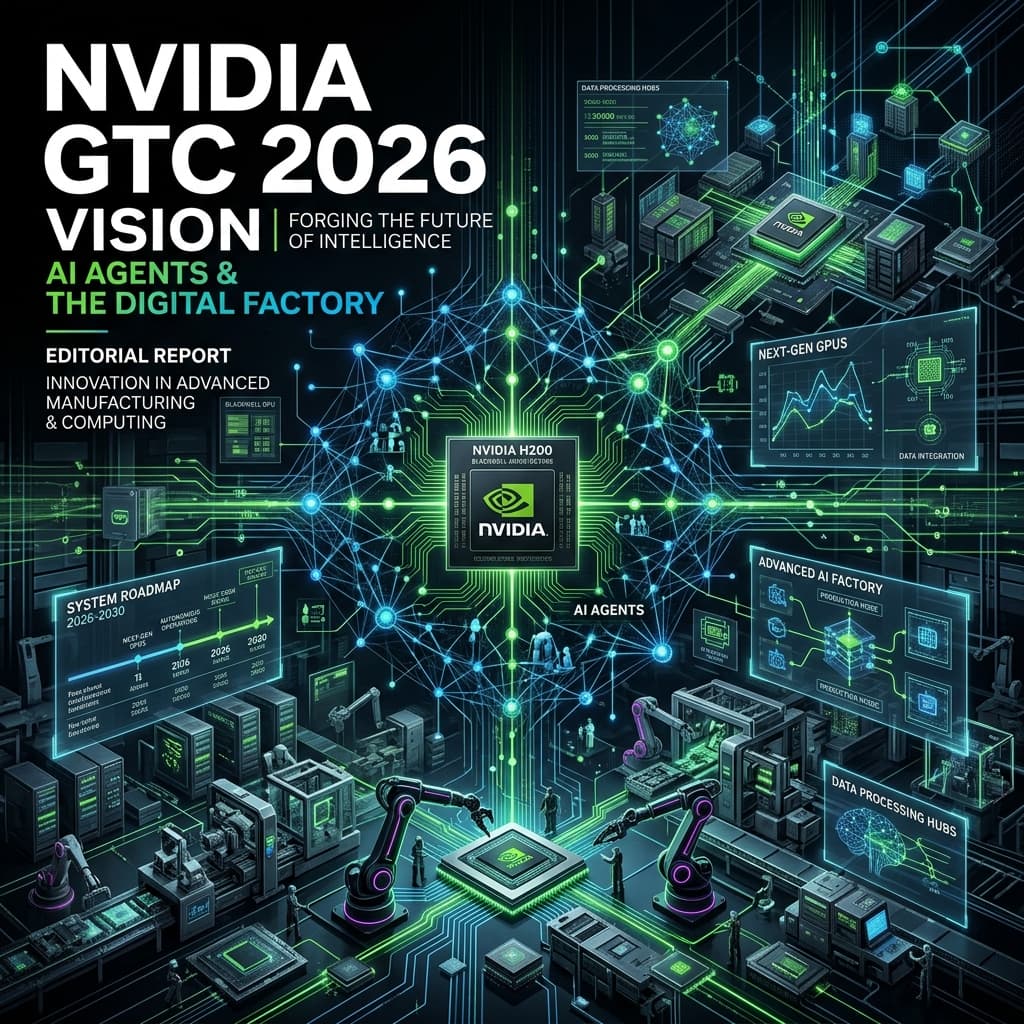
At NVIDIA GTC, Jensen Huang laid out a vision that signals the end of this introductory phase. The next chapter of artificial intelligence is not about generating text or images. It is about systems that reason, plan, coordinate tools, and execute workflows in the background. It is the evolution from chatbots to autonomous agentic architectures, and ultimately, toward what NVIDIA defines as Useful AI.
For NVIDIA, the metric of success is no longer a model's raw intelligence on paper. It is the model's capacity for practical execution.
The Shift From Intelligence to Execution
To understand the gravity of NVIDIA's roadmap, one must appreciate the structural limits of traditional Generative AI. A generative system is a statistical machine trained to predict the next token. If you ask it to build a web application, it outputs a raw block of HTML, CSS, and JavaScript. But it cannot open an IDE, compile the application, spin up a test container, evaluate the console logs, diagnose rendering bottlenecks, refactor its own errors, and deploy the working artifact to a cloud server.
The human operator remains the execution loop. The human must copy the code, test it locally, find the bugs, paste them back to the chat box, and repeat the loop. In this paradigm, AI is merely a smart compiler.
Agentic AIeliminates this friction by moving the execution logic inside the system. Instead of returning a block of text, an agent is given a objective (e.g., "Deploy a secure hotel booking portal under $50 budget"). The agent then initiates an internal cycle:
- Planning: Breaking down the goal into separate milestones (database design, API endpoints, payment integration).
- Tool Usage: Interacting with external software, APIs, compilers, and databases to write and test code.
- Self-Correction: Running a feedback loop where outputs are verified, errors are parsed, and plans are dynamically updated.
- Persistence: Operating asynchronously over hours or days without requiring constant human prompts.
The transition from chatbots to agentic architectures represents the leap from passive systems to active virtual workers. Rather than offering answers, they deliver finished work. In NVIDIA's lexicon, when agentic AI is deployed to consistently produce valuable business outcomes at scale, it becomes Useful AI.
The Journey from Generation to Utility
Click on any phase below to examine the internal loop architecture, metrics, and business impact.
Generative AI (Reactive)
The Text-Generation Wave
First wave (2022-2024) optimized for passive content creation. Responds only when prompted and forgets context immediately.
System Pipeline:
Performance Indicators
Why This Matters More Than a New AI Model
Every few months, the tech industry undergoes a wave of excitement over a minor decimal increment in a foundational model. Whether it is GPT-4.5, Claude 3.8, or Gemini 2.5, the narrative remains identical: a slightly higher score on the MMLU index, a slightly longer context window, and a slightly lower cost per million tokens.
But these marginal model improvements are hitting a wall of diminishing returns for businesses. Replacing a model that is 85% accurate with one that is 88% accurate rarely changes the viability of a business product. What limits AI adoption in the real world is not a lack of raw cognitive intelligence—it is a lack of integration, security, and context.
NVIDIA's GTC announcements matter because they focus on the layers around the model. By optimizing the hardware, the software libraries (CUDA-X), the pipeline orchestration, and the physical runtime environment, NVIDIA is creating a system where even a smaller, highly efficient open model (like a Llama 3B or Gemma 9B) can execute tasks that previously required massive, expensive closed models.
Infrastructure as the Real Competitive Moat
While startup model companies bleed venture capital training frontier networks from scratch, NVIDIA has quietly built the hardware-software stack that all these models must run on. If a new model comes out, it runs on NVIDIA chips. If an agency builds a multi-agent system, they optimize it using NVIDIA software. By securing the execution layer, NVIDIA controls the economic landscape of the AI economy.
This transition makes model commoditization inevitable. It shifts the competitive moat away from "who owns the smartest model" to "who owns the most efficient execution infrastructure."
Marginal Model Gains vs. Infrastructure Revolution
Toggle between model upgrades and infrastructure upgrades to see which delivers real business transformation.
CUDA-X: Re-engineering 20 Years of Software for Agents
One of the most profound aspects of Jensen Huang's GTC presentation was the focus on CUDA-X.
For twenty years, NVIDIA has steadily developed CUDA (Compute Unified Device Architecture) into a massive ecosystem of specialized libraries. If a researcher wanted to simulate the aerodynamic drag of a vehicle, analyze seismic data for energy exploration, calculate molecular folding structures for drug discovery, or render a photorealistic scene, they used a specialized CUDA-X library.
Historically, these libraries were highly technical assets. They required advanced degrees in computer science, mathematics, or physics to operate. A developer had to read dense documentation, understand parallel thread allocation, write C++ or Fortran wrappers, and manually debug memory allocation on GPU clusters.
NVIDIA's new architectural paradigm transforms this software catalog from a developer toolset into an ecosystem of skills for AI agents.
Rather than expecting a human programmer to write code using these libraries, NVIDIA is repackaging them so that AI agents can call them directly. If an agent is tasked with modeling a new chemical compound, it doesn't write basic code from scratch. It directly invokes a specialized, GPU-accelerated scientific library, feeds it the correct parameters, and gets the result in milliseconds.
This bridge shifts AI from general-purpose writing tools to highly specialized calculators. By equipping agents with CUDA-X, NVIDIA gives them the capability to solve real science, engineering, and data problems at accelerated speeds.
CUDA-X Agent Integration Hub
Select a library below to see how it acts as an specialized GPU skill for autonomous agents.
cuDNN / TensorRT
Inference AccelerationCore Capability:
Speeds up basic deep learning neural network processes, translating models into real-time executable software.
Impact on Autonomous Agents:
Reduces LLM latency to sub-second, allowing agents to respond, plan, and verify routes in real-time.
AI Factories and the Infrastructure of Execution
Historically, data centers were designed as digital warehouses. They housed databases, ran enterprise applications, and served web pages. They were passive environments built to store, retrieve, and transmit packets of data on demand.
Jensen Huang introduced the concept of the AI Factory to define a new class of infrastructure.
An AI factory is not a warehouse; it is a manufacturing plant. Its raw material is electricity and data, and its finished product is token generation—which translates directly into intelligence. These facilities are built from the ground up for massive parallel processing, using unified liquid-cooled supercomputers where thousands of GPUs function as a single, massive compute engine.
This shift in datacenter architecture is essential to power the agentic economy. Running a chatbot requires minimal compute; a user asks a question, the model responds, and the server goes quiet. Running a fleet of autonomous business agents, however, requires continuous, heavy compute.
Imagine an enterprise deploying 10,000 background agents to monitor network logs, handle customer service routing, manage inventory reconciliations, and run predictive marketing simulations. These agents are constantly thinking, evaluating, and interacting 24/7. The compute demand shifts from short, bursty spikes to a flat, high line of constant consumption.
AI Factories are the industrial engine designed to sustain this new world of continuous execution.
Loading compute cell...
Physical AI and the Rise of Robotics
While digital agents are transforming knowledge workflows, NVIDIA is also focused on bringing AI to the physical world. This is the domain of Physical AI—where intelligent systems move beyond screens and begin manipulating real-world matter.
The cornerstone of this effort is the integration of advanced neural networks with physical robotics. In the past, programming a robot was a rigid process. An engineer had to manually script every joint rotation, speed multiplier, and collision boundary. If the environment changed by a few centimeters, the robot would fail.
NVIDIA's physical AI platforms (like Omniverse and Isaac) use simulation to solve this. Robots are placed inside photorealistic, physically accurate virtual environments where they learn how to navigate, pick up items, and coordinate movements through reinforcement learning. By running millions of simulation loops in parallel, a robot can master complex physical tasks in hours before ever being deployed to a physical machine.
The implications for industries like logistics, manufacturing, and healthcare are massive:
- Smart Warehouses: Autonomous mobile robots (AMRs) that dynamically reroute based on foot traffic and inventory priority.
- Precision Agriculture: Robotic harvesters that identify ripe produce, evaluate health metrics, and pick items without damaging them.
- Medical Assistance: Robotic systems that manage surgical prep, organize sterile environments, and assist with physical physical therapy tasks.
By connecting digital intelligence to physical actuators, NVIDIA is laying the groundwork for a world where autonomous machinery works alongside humans to handle physical tasks safely and efficiently.
Loading compute cell...
The Future of Useful AI
As we move deeper into the decade, the metric of AI value will shift from novelty to utility.
Chatbots were the introductory hook. They proved that natural language could serve as a universal interface for computing. However, a business cannot survive on chat windows alone. The actual productivity gains from employees copy-pasting text back and forth are marginal.
The future belongs to Useful AI. A useful system is invisible, autonomous, and integrated. It operates within your existing databases, monitors your workflows, and takes action to achieve business objectives without requiring manual prompts.
Instead of a project manager asking an AI to write a task list, the system automatically analyzes emails, generates the tasks, assigns them to team members, creates Git branches for developers, schedules code reviews, and tracks progress. The AI is no longer a helper; it is the infrastructure layer of the business.
This transition will redefine how we measure software. We will stop evaluating tools based on their features and start evaluating them based on their execution capability.
How Useful AI Replaces Manual Workflows
Watch the AI system autonomously execute a full project management cycle — no human prompts required.
Monitor Email
Scans inbox for project updates and client requests
What This Means for Businesses
For established enterprises and mid-market companies, NVIDIA's shift from model-centric AI to execution-centric infrastructure requires a change in digital strategy.
Many businesses have spent the last two years running pilots with simple wrappers. They built custom chatbots for internal knowledge retrieval or basic customer support. While these pilots were useful learning exercises, they rarely impact the company's bottom line.
To capture the real opportunity of this shift, businesses must focus on three areas:
1. Workflow Mapping
Before deploying AI agents, you must document your existing workflows in detail. An agent cannot automate a process that is undefined or relies on undocumented human intuition.
2. Unified Data Infrastructure
AI agents require secure, real-time access to corporate databases, CRMs, and project management tools. Siloed, fragmented data is the single greatest bottleneck to agentic execution.
3. Guardrails and Oversight
Because agents take actions (sending emails, committing code, running transactions), companies must implement clear boundaries, verification steps, and human-in-the-loop approvals.
The businesses that succeed will be those that transition from treating AI as a writing assistant to treating it as an operational system.
Is Your Business Agent-Ready?
Rate your organization across the three critical pillars. Adjust the sliders to see your readiness score.
Workflow Mapping
How well-documented are your business processes?
Data Infrastructure
Can agents securely access your databases and CRMs in real-time?
Guardrails & Oversight
Do you have approval workflows and verification gates for AI actions?
What This Means for Startups
For startup founders, the transition to agentic execution represents a massive opportunity to outmaneuver legacy incumbents.
Startups can build their operations as AI-native systems from day one. Rather than hiring large administrative, operations, and support teams, a modern startup can build a lean core team of engineers who design and oversee a network of autonomous agents.
This changes how we evaluate operational leverage:
- Capital Efficiency: Startups can scale their operations, handle thousands of customers, and manage logistics with a fraction of the headcount previously required.
- Agility: An agentic startup can refactor its business logic, pivot its pipelines, and integrate new tools in hours rather than weeks of human training.
- Bespoke Solutions: Startups can offer highly customized, real-time services to clients by deploying individual agent instances tailored to each account.
Founders should stop building simple model wrappers and focus on building deep integration layers that solve specific, complex workflows.
What This Means for Developers
For software engineers, the transition to agentic architectures shifts the nature of coding.
Writing syntax is becoming a commoditized skill. AI systems can generate code blocks instantly. The real value for developers is shifting toward system architecture, pipeline design, security engineering, and context management.
Instead of spending hours writing boilerplate code, developers will focus on:
- Agent Coordination: Designing systems where multiple specialized agents collaborate, share state, and pass tasks to one another.
- Interface Engineering: Building clear APIs, database schemas, and tool descriptions so that AI systems can read, understand, and call them reliably.
- System Verification: Creating automated testing frameworks, CI/CD pipelines, and monitoring tools to ensure agents execute actions correctly and safely.
The developers who thrive will be those who view AI not as a replacement for engineering, but as a new component in their system architecture.
How Developer Time Allocation Is Shifting
Toggle between eras to see how the value of engineering skills is being restructured by agentic AI.
In the pre-agent era, 70%+ of a developer's time is spent on commodity work — writing boilerplate, fixing syntax, and running manual tests. High-value architecture and security work is deprioritized.
Share this article
Stay Ahead of the Curve
Get the latest breakthroughs in AI, space technology, automation, and tech strategy delivered directly to your inbox. No spam. Only engineering intelligence.
By subscribing, you agree to receive communications from GrowXLabsTech.
Ready to Build AI Agents For Your Business?
GrowXLabs helps businesses design AI-native systems, automation workflows, lead generation engines, and intelligent agents that drive real growth.