Was this newsletter forwarded to you? Sign up to get it in your inbox.
1. Introduction
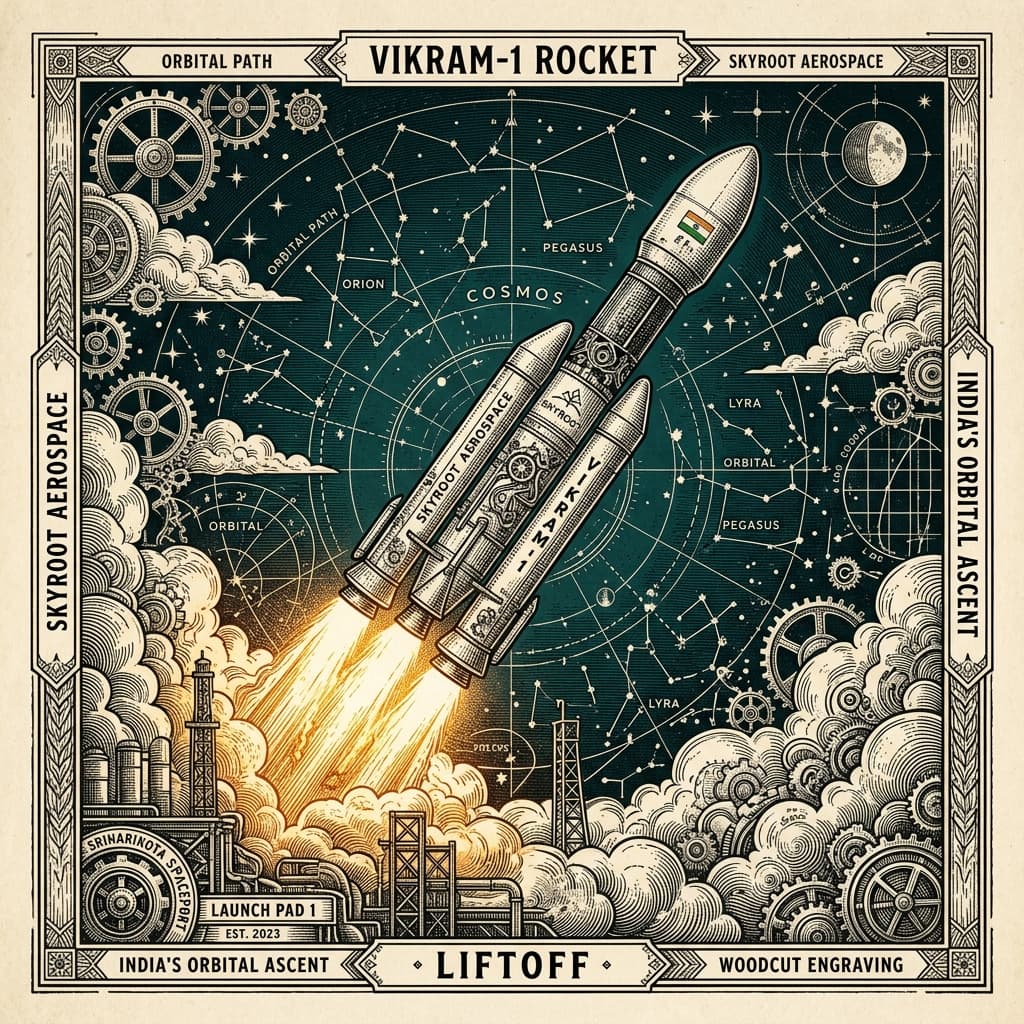
On 18 July 2026, a 22-meter column of carbon fiber composite and solid propellant lifted off from the Satish Dhawan Space Centre in Sriharikota. Fifteen minutes later, telemetry confirmed what satellite operators had been waiting to see: Vikram-1 had achieved orbital insertion, deploying customer payloads into a 450-kilometer Low Earth Orbit.
The mission, codenamed Aagaman—Sanskrit for "Arrival"—marked the first time a privately developed Indian rocket reached orbit, establishing India as a serious player in global small-satellite deployment.
2. About Skyroot Aerospace
Founded in 2018 by former ISRO engineers Pawan Kumar Chandana and Naga Bharath Daka, Hyderabad-based Skyroot Aerospace set out to build low-cost, rapidly deployable small-satellite launch vehicles. Following the successful test flight of Vikram-S in 2022, Vikram-1 represents the company's full-scale orbital vehicle.
3. The Vikram-1 Rocket: Engineering & Architecture
Vikram-1 is a 3-stage solid-propellant launcher paired with a 3D-printed liquid-propellant upper stage (Raman-1) for precision final insertion.
| Parameter | Specification |
|---|---|
| Overall Height | 22 Meters |
| Gross Lift-off Mass | ~48 Metric Tons |
| Payload Capacity | 300 kg to 500 km LEO / 480 kg to 500 km SSO |
| Body Construction | All-Carbon Fiber Composite Airframe |
| Upper Stage Engine | Raman-1 (3D-Printed Hypergolic Liquid Engine) |
4. Mission Aagaman: Launch Execution
Liftoff occurred at 06:14 UTC. Stage 1 (Kalam-1200) fired for 108 seconds, generating over 1,200 kN of thrust. Stage 2 and Stage 3 performed flawlessly before the Raman-1 upper stage executed a closed-loop trim burn to circularize the orbit.
5. Key Technological Innovations
Skyroot's Raman-1 engine is entirely 3D printed out of high-strength nickel alloy, reducing component count by 80% and manufacturing lead time from months to under 48 hours.
6. Commercial & Strategic Importance
With global demand for small-satellite constellation replenishment growing rapidly, Vikram-1 offers satellite operators rapid 24-hour turnaround integration at competitive pricing.
7. Future Roadmap: Vikram-2 & Beyond
Skyroot is actively developing Vikram-2 (capable of delivering 500 kg to SSO) and liquid-cryogenic LNG/LOX engines for reusable launch vehicle stages.
Key Takeaways
- ► Vikram-1 achieved orbital insertion on July 18, 2026 under Mission Aagaman.
- ► All-carbon composite structure with 3D printed Raman-1 liquid upper engine.
- ► Unlocks commercial small-sat launch capacity for global customers out of Sriharikota.
Share this article
Frequently Asked Questions (FAQ)
What is Vikram-1?
Vikram-1 is a multi-stage small-satellite launch vehicle developed by Skyroot Aerospace, capable of delivering up to 300 kg to Low Earth Orbit (LEO).
What is Mission Aagaman?
Mission Aagaman is the maiden orbital flight of Vikram-1, executed on July 18, 2026 from the Satish Dhawan Space Centre in Sriharikota.
Who founded Skyroot Aerospace?
Skyroot Aerospace was founded in 2018 in Hyderabad by former ISRO scientists Pawan Kumar Chandana and Naga Bharath Daka.
What propulsion system powers Vikram-1?
Vikram-1 utilizes high-durability solid-propellant stage motors (Kalam series) combined with a 3D-printed liquid upper stage engine (Raman-1) for precision orbital insertion.

Kimi K3 Technical Analysis: Inside Moonshot AI's Open Frontier Model
Deep technical report on Moonshot AI's 2.8T parameter open-weight Mixture-of-Experts architecture and benchmarks.

Blue Origin’s New Glenn Rocket Explodes During Test: What Happened?
Blue Origin's New Glenn rocket exploded during a hot-fire test in Florida. Here's what happened and why it matters.

ChatGPT GPT-5.6 Preview: Everything You Need to Know
Explore the new tiered family of models (Sol, Terra, Luna) and discover its advanced reasoning and coding capabilities.
Was this newsletter forwarded to you? Sign up to get it in your inbox.