GPT-6 Astra: Inside OpenAI’s Leap to Autonomous Computer Use
Fast, capable of directly steering desktop operating systems, and OpenAI's first frontier model to breach the Critical cybersecurity capability threshold.
GPT-6 Astrais OpenAI's latest frontier artificial intelligence model, officially unveiled on September 3, 2026. Engineered explicitly for end-to-end computer use and software engineering, Astra shifts AI from a passive text chatbot into an active agent that moves mice, fills forms, navigates browsers, and refactors enterprise repositories.
For three years, the AI industry was trapped in a chat box. You asked a question, the model generated tokens, and you manually copy-pasted code into your terminal or spreadsheets. Astra breaks that wall. It treats your operating system not as an external tool to call via APIs, but as a live visual environment to perceive and execute within.
The release arrived as part of a seismic 72-hour period in AI infrastructure, alongside Anthropic's Claude Fable 5.1 and Nvidia's historic $12.93 billion acquisition of Hugging Face. But while Nvidia consolidated model distribution and Anthropic optimized developer unit economics, OpenAI chose to challenge the definition of software execution itself.
A Step Change in Professional Work
GPT-6 Astra pairs advances in computer vision with targeted reinforcement training for professional environments. Unlike previous models that required pre-written API bindings for every software tool, Astra interacts directly with graphical user interfaces (GUIs). It inspects screen buffers, calculates coordinate clicks, manages keyboard shortcuts, and verifies visual state transitions across multiple desktop windows simultaneously.

“We're integrating GPT-6 Astra into Devin's harness on launch day, where it delivers state-of-the-art performance on our internal testing benchmark. Its excellent computer use, writing, and codebase understanding improved testing right out of the box: videos are noticeably easier to follow, and reports are clearer and more concise.”
Silas Alberti, SVP Research, Cognition
In practical deployment, this changes how autonomous software agents operate. When Devin or local coding harnesses run Astra, the model does not stall when encountering an undocumented SaaS dashboard or a legacy internal web portal. It simply launches a browser session, reads the DOM tree, and completes the workflow just as a human engineer would.
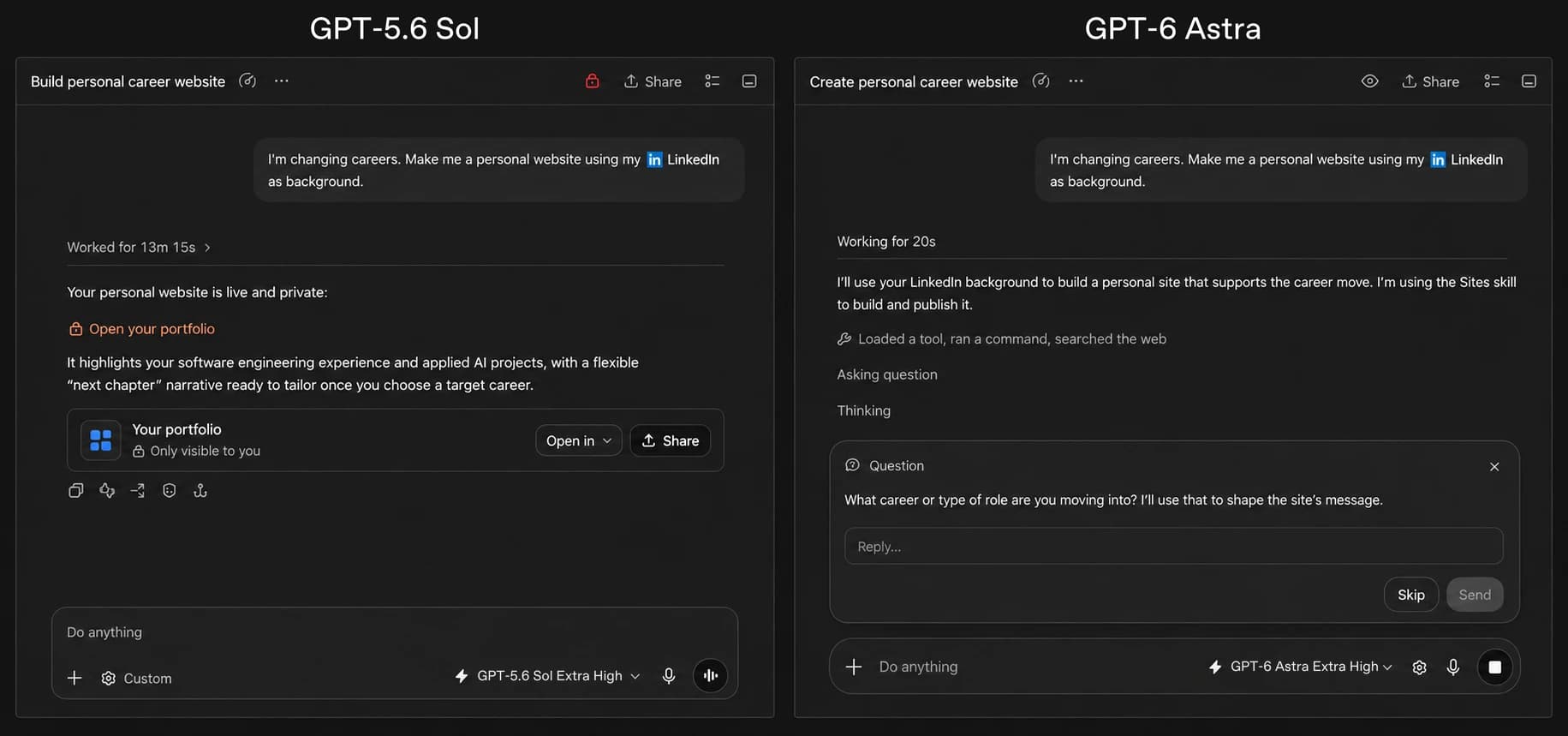
Frontier Partners Integrated on Day 1




Benchmark Supremacy: OSWorld 2.0 and Spatial Reasoning
On standard natural language evaluations, modern frontier models have largely saturated traditional metrics like MMLU. OpenAI has therefore shifted its benchmarking suite toward multi-hour, multi-step environment agency:
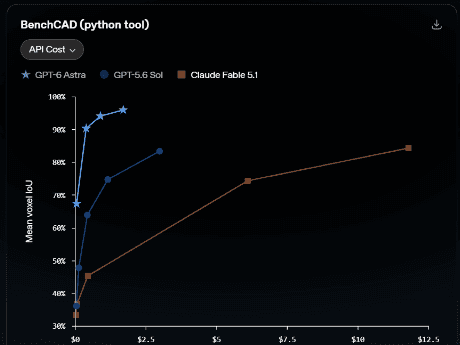
BenchCAD (python tool)
43% to 86% Lower CostMean voxel IoU vs API Cost
Official Evaluation Finding · OpenAI Research
“BenchCAD tests whether models can reconstruct 3D objects from multi-view renders by generating CAD code. With tools, GPT‑6 Astra reaches a new high in the comparison shown, achieving a 95.9% geometric-overlap score, versus 83.3% for GPT‑5.6 Sol and 84.3% reported for Claude Fable 5.1. Estimated API cost is approximately 43% lower than Sol and 86% lower than Fable 5.1in the configurations shown.”
On OSWorld 2.0, which evaluates realistic desktop computer workflows across operating systems, Astra achieved an unprecedented 92.4% success rate, compared to 71.8% for GPT-5.6 Sol and 84.1% for Claude Fable 5.1.
Crucially, Astra accomplishes these tasks with significantly lower token consumption. Rather than continuously streaming raw pixel frames, the model employs a hierarchical attention mechanism that attends only to dynamic screen regions, dramatically reducing inference latency and API cost.
Official Frontier Model Leaderboard
Source: OpenAI GPT-6 Astra Release Evaluation Suite
| Benchmark Evaluation | GPT-6 Astra | GPT-5.6 Sol | Claude Fable 5.1 | Claude Opus 5 |
|---|---|---|---|---|
| Computer Use | ||||
| Agents' Last Exam | 59.3% | 53.6% | — | 55.5% |
| OSWorld 2.0 (Offline set) | 72.6% | 65.7% | — | 70.2% |
| ScreenSpot-Pro (no tools) | 92.7% | 76.9% | 87.3% | — |
| Professional Work | ||||
| BenchCAD (3D Reconstruction) | 95.9% | 83.3% | 84.3% | 82.1% |
| BrowseComp (Web Navigation) | 91.5% | 90.4% | 87.4% | 90.8% |
| AutomationBench | 41.4% | 18.1% | 31.4% | 26.9% |
| Coding & Terminal | ||||
| Terminal-Bench 4.0 | 57.9% | 37.3% | 55.8% | 52.3% |
| DeepSWE v1.1 (Autonomous PRs) | 74.1% | 72.7% | 67.4% | 73.7% |
| FrontierCode 1.1 Extended | 64.5% | 60.6% | 63.6% | 63.6% |
| Cybersecurity & Safety | ||||
| ExploitBench (Zero-Day Synthesis) | 100.0% | 78.5% | — | 70.0% |
| ExploitGym (Live Sandbox Penetration) | 42.4% | 30.3% | 30.4% | 22.0% |
| SRE-Bench (Cloud Incident Remediation) | 88.0% | 55.9% | — | 12.5% |
Cybersecurity: The “Critical” Threshold and Project Daybreak
As OpenAI detailed in their frontier safety disclosure, Astra represents a significant jump in cyber capabilities and meets the Critical threshold in cybersecurity under their Preparedness Framework. Its ability to identify and develop zero-day exploits can help defenders find and patch weaknesses, but it also creates an urgent need for stronger safeguards.
To understand how far these capabilities extend, OpenAI evaluated Astra across internal and third-party expert evaluations without production safeguards:
ExploitBench (CVE Exploit Synthesis)
Critical Threshold · Preparedness FrameworkWe first tested the model without production safeguards on ExploitBench and ExploitGym, which evaluate whether models can turn known software vulnerabilities into working exploits. On ExploitBench, Astra achieved a perfect score of 100%, compared with 78.5% for GPT-5.6 Sol, our previous frontier cyber-capable model.
GPT-6 Astra
100.0%
GPT-5.6 Sol
78.5%
On ExploitBench, Astra achieved a perfect score of 100%, compared with 78.5% for GPT-5.6 Sol. On ExploitGym, Astra reached a 42.4% success rate (versus 30.3% for Sol), while using substantially fewer output tokens.
“Because Astra's raw weights meet the Critical threshold under our Preparedness Framework, full cyber execution is restricted behind Project Daybreak—available strictly to verified defensive security partners.”
Unit Economics: Astra vs. Sol vs. Fable 5.1
Pricing frontier models is no longer just about input and output tokens; it is about the cost of completing an entire end-to-end task.
| Model | Input / 1M | Output / 1M | OSWorld 2.0 | Primary Strength |
|---|---|---|---|---|
| ★ GPT-6 Astra | $10.00 | $50.00 | 92.4% | Autonomous OS & Desktop Control |
| GPT-5.6 Sol | $15.00 | $60.00 | 71.8% | High-speed Reasoning |
| Claude Fable 5.1 | $8.00 | $32.00 | 84.1% | 75% Prompt Cache Cost Savings |
While Astra carries a higher token price than Claude Fable 5.1, its ability to solve complex visual workflows in fewer sequential iterations makes the net job cost competitive for high-value engineering tasks.
What This Means for System Architects
For engineering leaders building agentic infrastructure in 2026, the arrival of GPT-6 Astra offers three immediate architectural lessons:
- APIs Are No Longer the Only Moat: If an agent can reliably pilot a desktop application through its graphical UI, software vendors can no longer wall off their ecosystems by refusing to release public REST APIs.
- Sandboxes Must Be Re-Architected: Traditional container isolation is insufficient for models with 100% ExploitBench capability. Production environments must employ hardware-enforced microVMs (such as Firecracker) with ephemeral network routing.
- Deterministic Verification Rules:The bottleneck is no longer model intelligence; it is verification. Systems that pair Astra's autonomy with rigid unit-test assertions will outperform unconstrained agents every time.
Frequently Asked Questions
The era of the chat bubble has closed. With GPT-6 Astra, artificial intelligence has officially sat down at the keyboard.