Ferrari’s Electric Future: Why The Luce Marks A Historic Turning Point
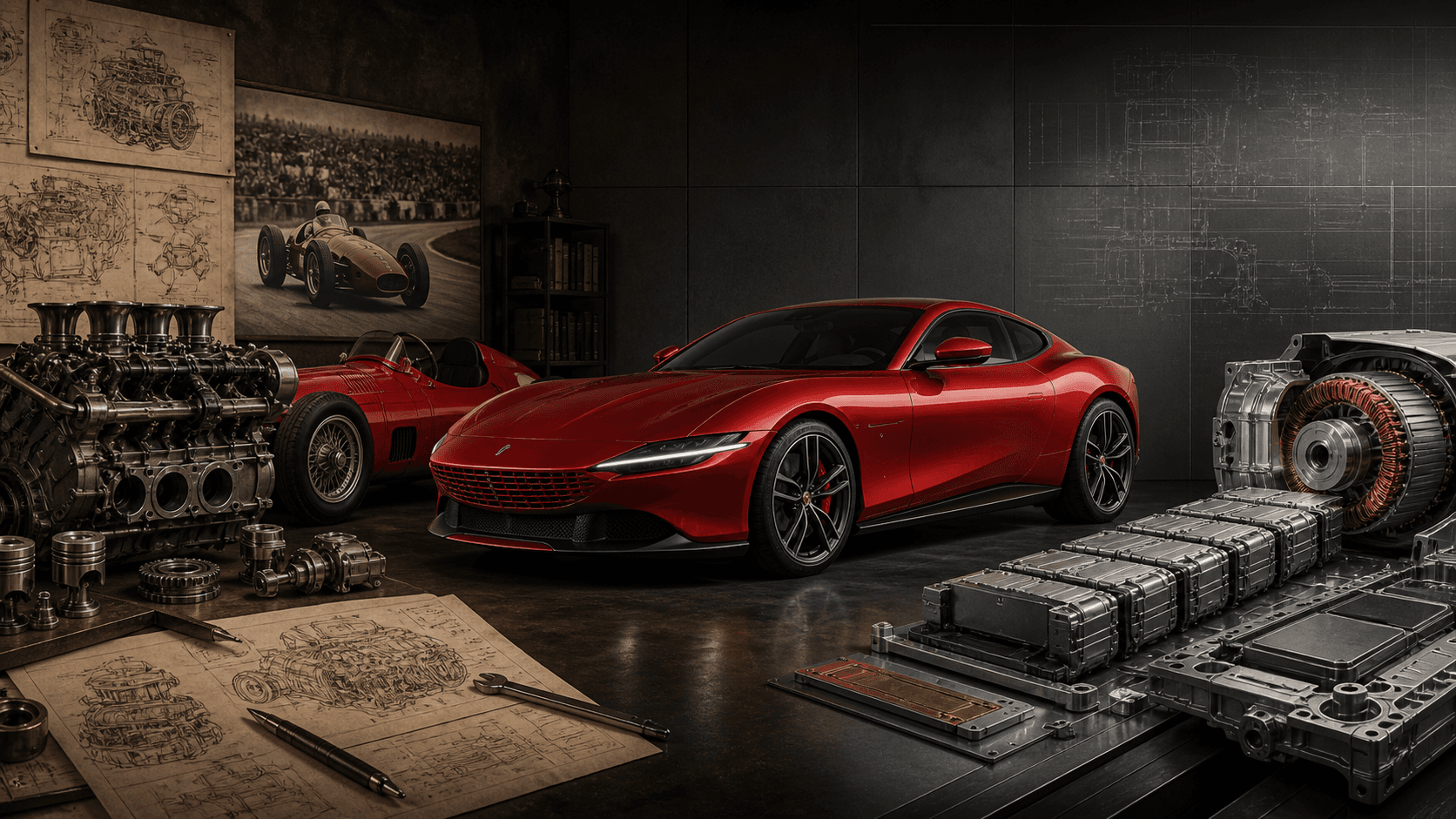
Ferrari’s Electric Future: Why The Luce Marks A Historic Turning Point
This is not simply another car launch. It is a cinematic glimpse into how even the most iconic, heritage-focused brands in the world adapt and redefine themselves when confronted by a shifting technological horizon.
Ferrari’s transition from mechanical V12 combustion engines to the Luce solid-state axial-flux platform represents a major shift in luxury engineering, trading thermal expansion dynamics for direct software-defined torque vectoring.
- Peak Output:1400 Horsepower
- Energy Density:480 Wh/kg (Solid-State)
- Torque Latency:1.2ms Sync Speed
What it means:Updating long-established manufacturing before the market forces the change is critical. Ferrari shows that protecting a brand's heritage and investing in new software can work together.
For decades, Ferrari represented something larger than performance.
It was the mechanical sound of a naturally aspirated, high-revving engine. It was limits pushed on the boundaries of mechanical tolerance. A visceral driving experience built around pure human emotion rather than digital convenience.
That uncompromising identity helped Maranello become one of the most respected automotive brands and absolute symbols of luxury in the world.
Now, Ferrari is entering a completely new chapter. The company has officially unveiled the Ferrari Luce, its first fully electric hypercar, signaling one of the biggest structural transformations in its history.
More Than An Electric Vehicle
Most electric vehicle launches follow a predictable, highly commoditized formula. They highlight battery sizes in kilowatt-hours, high-speed charging curves, absolute ranges under testing cycles, and sprint performance numbers from zero to sixty.
But Ferrari's announcement operates in a different paradigm. The significance of the Luce is not about technical specifications. The significance is what it represents.
“Ferrari built its entire legacy on mechanical internal combustion excellence. Evolving from that foundation is the ultimate proof that no brand can protect the past forever.”
Many enthusiasts believed the company would be one of the last luxury manufacturers to fully embrace electrification. Instead, Ferrari has chosen to actively participate in shaping the future.
The Luce is proof that even legendary brands cannot ignore technological shifts. Electrification is no longer a niche alternative; it is the fundamental medium of future automotive design.
THE END OF THE COMBUSTION ERA
V12 MECHANICAL
| ENGINEERING PARAMETER | V12 MECHANICAL CORE (OLD) | LUCE AXIAL-FLUX ELECTRIC (NEW) |
|---|---|---|
| Power Density Core | Mechanical displacement (~830 HP peak) | Triple Axial Flux motors (1400 HP peak) |
| Energy Medium | Liquid hydrocarbon / Fuel combustion | Solid-State structural battery matrix (480 Wh/kg) |
| Drivetrain Latency | 80-120ms (Mechanical gear sync and throttle) | 1.2ms (Algorithmic direct current delivery) |
| Acoustic Profile | Natural high-rev exhaust resonance (V12 note) | Algorithmic structural resonators (Acoustic feedback) |
| Slip Yaw Controls | Reactive hydraulic locking differentials | Proactive neural slip yaw controllers (Torque vector) |
| Carbon Footprint | High local emissions profile | Zero tailpipe emissions (Carbon-neutral supply chain) |
Why Ferrari Had To Change
The automotive industry is undergoing a structural disruption unlike anything seen in the last century. Governments are introducing stricter emissions limits, cities are proposing full internal combustion bans, and a new demographic of environmentally-conscious luxury buyers is asserting control of the market.
The challenge facing Ferrari was clear: continue protecting the mechanical systems of the past or actively build the software-driven infrastructure of the future. The company chose the latter.
Rather than waiting for disruption to render their legacy systems obsolete, Ferrari is actively preparing for the next generation of luxury buyers. Evolving early allows them to define the rules of electric performance, rather than playing catch-up to newer, agile competitors.
THE STRATEGIC ROADMAP TO ELECTRIFICATION
Regulatory Impetus — Phase 1
Global governments draft strict timelines to ban combustion vehicle sales in major cities. Enforces unprecedented efficiency thresholds on boutique luxury builders.
The Internet Is Divided
The response to the Luce has been intense. For traditional purists, the move feels like an abandonment of the brand's core soul. They argue that electric motors cannot replace the organic acoustics, micro-vibrations, and mechanical connection of a high-revving Ferrari V12.
On the other side, technology visionaries acclaim the launch. They see the Luce as an inevitable, exciting integration of high-density solid-state batteries and intelligent chassis controls that will push lateral G-forces and handling dynamics beyond mechanical limits.
Electrification does not mean losing the driving soul; it means discovering a different dimension of responsiveness. When software controls power delivery 1,000 times a second, the physical relationship between driver and machine becomes incredibly intimate.
THE DILEMMA: HERITAGE RESISTANCE VS. FUTURE ACCLAIM
Hover over network nodes to extract demographic arguments, quotes, and concern parameters.
Luxury Is Being Redefined
The definition of luxury is undergoing a major paradigm shift. In previous decades, luxury was represented by raw mechanical excess: larger cylinder counts, massive displacements, high fuel consumption, and heavy chassis builds.
Today, luxury increasingly means:
- Intelligent software-defined chassis systems
- Conscious, sustainable craftsmanship
- Proprietary digital telemetry networks
- Instantaneous, zero-lag kinetic control
Modern elite buyers expect technical innovation. Brands that fail to transition their interfaces and drivetrains risk looking like relics of a past century. The Luce is Ferrari's definitive attempt to bridge heritage prestige with high-end tech ecosystems.
THE MODERN LUXURY ECOSYSTEM REDEFINED
PERFORMANCE DYNAMICS
Beyond Traditional Top Speed
True luxury is no longer just high speeds in a straight line. It is lateral traction, predictive slip controllers, zero drivetrain lag, and immediate, linear power delivery optimized per millisecond.
PERFORMANCE DYNAMICS
Beyond Traditional Top SpeedDIGITAL INTELLECT
Predictive Software ControlSUSTAINABLE ENGINEERING
Conscious Prestige StatusSOVEREIGN STATUS
Limited Aesthetic PrestigeWhat Businesses Can Learn From Ferrari
The most profound takeaway from this transition extends far beyond automotive manufacturing. It applies directly to any modern organization: startups, agencies, enterprise platforms, and digital product builders.
Every successful company eventually confronts the critical question:
Many organizations fall victim to their own historical success. They protect old workflows, resist incorporating artificial intelligence or automation, and delay infrastructure migrations to avoid immediate friction. Eventually, faster competitors pass them by.
Ferrari's strategy shows the correct path. They are retrofitting their manufacturing capabilities, investing in software R&D, and re-educating their artisanal engineering talents while they are still highly profitable.
THE STRATEGIC TRANSFORMATION SYSTEM OS
Protect brand prestige and craftsmanship values
Develop proprietary OS, algorithms, dynamics
Configure factories for modular hardware integration
Educate engineers on code, circuitry, and cells
HIGH RISK OF OBSOLESCENCE
⚠️ Legacy preservation alone risks competitive displacement by software-first hypercar platforms.
The Bigger Picture
The Ferrari Luce represents something much wider than a premium vehicle release. It is the ultimate collision between legacy craftsmanship and deep software innovation.
It serves as a stark reminder: no industry is immune to technological disruption. Whether it is automotive engineering, enterprise software development, content media, or global digital business, the future belongs entirely to organizations that choose to adapt.
Final Thoughts
The Ferrari Luce will likely be remembered as one of the most important product decisions of this decade. Not because it is electric or controversial, but because it represents the courage to transform.
The future does not wait for legacy players to feel comfortable. Ferrari has made its choice, setting a new benchmark for brand adaptation. The only remaining question is whether the rest of the industry is ready to do the same.
Frequently Asked Questions
The Ferrari Luce represents Maranello's first fully electric hypercar, transitioning the brand from mechanical internal combustion engines to a software-defined, electric powertrain. It proves that heritage brands can preserve luxury status while actively adapting to sustainable technology.
Ferrari engineers integrated lightweight solid-state battery cells directly into the carbon-fiber monocoque chassis (480 Wh/kg energy density). Coupled with three high-density axial flux motors, this reduces chassis weight while delivering a 1.2ms torque vectoring sync latency for unmatched track agility.
Yes, the Luce incorporates structural acoustic resonators mapped to raw motor spin frequencies. This translates the electric power cycles into emotional sound and vibrational feedback, replacing the V12 exhaust note with a direct digital-mechanical acoustic profile.
Startups and enterprises must evolve before change becomes unavoidable. Rather than delaying transformation to protect legacy cash cows, Ferrari proactively retrofitted its manufacturing, retrained artisanal talent, and invested in software R&D while remaining highly profitable.